







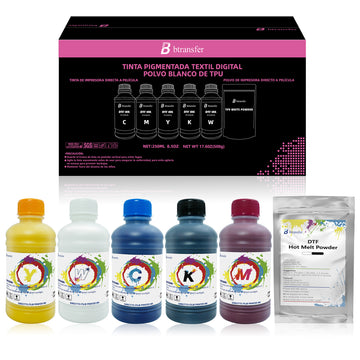


When it comes to Direct-to-Film (DTF) printing, adhesive powder is easy to overlook, yet it directly affects how well a design bonds to fabric, how comfortable the print feels, and how it performs in everyday use.
Different types of hot-melt adhesive powder suit different applications. In this guide, we cover the main types, their advantages and limitations, and why Bbtransfer Hot Melt Adhesive Powder is a practical choice for everyday DTF printing.
1. What Is TPU Hot-Melt Adhesive Powder?
TPU hot-melt adhesive powder is a heat-activated adhesive used in DTF printing. After a design is printed onto PET transfer film, the powder is applied to the wet ink and heated to form an adhesive layer that bonds the design to the fabric during heat pressing.
The powder influences five key aspects: adhesion, flexibility, softness, wash durability, and printing precision. Results also depend on ink quality, transfer film, curing conditions, heat press settings, and fabric composition.
2. Understanding the Different Types of TPU Hot-Melt Adhesive Powder
Depending on particle size, formulation, and performance characteristics, different powders suit different applications. Here are six common categories.
2.1 Fine Powder: Designed for Detailed Prints
Fine powder's smaller particles provide precise coverage for intricate designs, small text, and thin lines. It helps achieve cleaner edges, but requires careful handling and adds limited value on large, simple graphics.
Best for: small logos, fine text, detailed artwork.
2.2 High-Elasticity Powder: Designed for Stretchable Fabrics
Developed for garments that stretch or move frequently, such as sportswear and yoga clothing, it reduces cracking caused by fabric movement. Its specialized benefits are usually unnecessary for standard cotton T-shirts and may add cost.
Best for: sportswear, yoga clothing, compression garments.

2.3 Coarse Powder: Designed for Open-Weave and Mesh Fabrics
Coarse powder has larger particles and may suit certain heavy-duty or mesh fabrics. However, it is less suitable for fine details and lightweight materials.
Best for: Selected heavy-duty and mesh fabrics.

2.4 Soft Powder: Designed for Comfort
Soft powder prioritizes a soft, comfortable feel after transfer, making it suitable for garments worn close to the skin, such as underwear. Softness alone does not guarantee better adhesion or durability, and trade-offs may exist.
Best for: underwear, premium casualwear, loungewear.
2.5 Economy Powder: Designed for Cost-Sensitive Production
Economy powder targets high-volume, promotional, and price-sensitive orders. It lowers material costs, but offers fewer specialized features, and performance depends on the formulation.
Best for: budget-oriented apparel, promotional products.
2.6 General-Purpose Powder: Designed for Everyday Printing
General-purpose powder balances performance, versatility, and cost for common printing jobs. It suits a wide range of standard garments and simplifies material selection, but is not optimized for highly specialized applications.
Best for: standard T-shirts, casualwear, everyday apparel.
3. Quick Comparison: Which DTF Powder Should You Choose?
| Powder Type | Main Advantage | Potential Limitation | Recommended Application |
|---|---|---|---|
| Fine Powder | Detailed printing | Requires careful powder handling | Small text, logos, fine lines |
| High-Elasticity Powder | Flexibility and stretch performance | Specialized properties may be unnecessary for standard garments | Sportswear, yoga clothing |
| Coarse Powder | Suitable for open-weave fabrics | Less suitable for fine details | Mesh jerseys, Oxford fabric |
| Soft Powder | Comfortable hand feel | May involve performance trade-offs | Underwear, loungewear |
| Economy Powder | Cost efficiency | Performance depends on formulation | Budget-oriented production |
| General-Purpose Powder | Balanced everyday performance | Not optimized for every specialized application | Standard T-shirts, everyday apparel |
As the comparison shows, no single powder performs best in every situation. The ideal choice depends on the fabric, the design, and the expected performance of the finished product.
4. Why We Recommend Bbtransfer Hot Melt Adhesive Powder
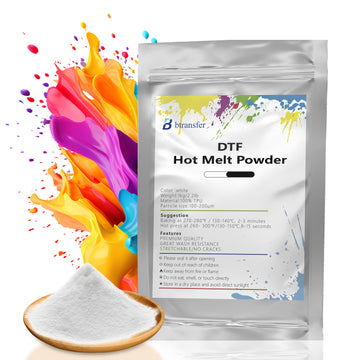
With a particle size of 100–200 μm, Bbtransfer Hot Melt Adhesive Powder is a general-purpose option that balances performance, versatility, and cost for everyday DTF printing. It suits T-shirts, casualwear, and other standard garments—whether custom apparel, small-batch orders, or regular transfers—and simplifies production by reducing switching between specialized powders.
It is not intended to replace specialized products: for highly stretchable sportswear, extremely detailed graphics, or large mesh openings, a specialized formulation may be more suitable. For standard, everyday garment printing, Bbtransfer Hot Melt Adhesive Powder is well worth considering.
5. DTF Hot Melt Adhesive Powder: Types, Differences & How to Choose
Before selecting powder, consider the following questions.
Fabric: standard cotton and common blends work well with general-purpose powder, while highly elastic or open-weave materials may need specialized formulations.
Design: fine lines, small lettering, and intricate graphics may require finer powder for precise coverage.
Comfort and flexibility: more important for close-fitting garments and sportswear than for standard promotional apparel.
Production priorities: versatility, specialized performance, or material cost?
Testing: even similar-looking powders differ in formulation, so test with your ink, film, fabric, and heat press settings before large-scale production.
6. Final Thoughts: Find the Right DTF Powder for Your Printing Needs
Choosing hot-melt adhesive powder is not about picking the finest, softest, most elastic, or cheapest option—each type has its place. For businesses handling a variety of everyday garment printing jobs, a versatile general-purpose powder makes daily production more convenient.
B btransfer Hot Melt Adhesive Powder, with its 100–200 μm particle size and balanced positioning, is a practical starting point for standard T-shirts, casualwear, and common DTF printing applications.
Looking for a Reliable TPU Hot-Melt Adhesive Powder?
Discover B btransfer Hot Melt Adhesive Powder for versatile, practical everyday DTF printing.


