









TPU 3D Badge Film — if you are a beginner just entering the printing industry, this term may be relatively unfamiliar to you.
Even if you already have DTF printing experience, you may not necessarily be familiar with TPU. This is because traditional DTF and UV DTF are themselves two different printing methods, and the role TPU plays in them is also different.
First, one point needs to be made clear:
TPU 3D Badge Film is not another name for ordinary DTF transfer film.
If you are already familiar with DTF and also want to try a different method of apparel customization, then learning about TPU would be a good start.
What is TPU?
The full name of TPU is: Thermoplastic Polyurethane.
Simply put, TPU is a thermoplastic material that combines a certain degree of flexibility, elasticity, and abrasion resistance.
Compared with some harder plastics, TPU can adjust its softness and elasticity according to different formulations, so it is often used in: films, footwear, industrial parts, and other products that require flexibility and elasticity.
From a chemical structure perspective, TPU is usually formed by the reaction of three main raw materials: polyols, diisocyanates, and short-chain diols.
Depending on the polyol used, TPU can also be divided into different types such as polyester type and polyether type. Different formulations affect the material's flexibility, hydrolysis resistance and heat resistance.
However, if your main focus is printing and making personalized products, you do not need to delve deeply into the chemical structure of TPU.
Next, this article will intuitively guide you through TPU film and DTF transfer film.

What is the difference between TPU film and DTF transfer film?
This is the most confusing part.
Although TPU film and traditional DTF transfer film both appear as “film” in the printing process, they are not the same material, and they serve different purposes in actual production.
The transfer film used in traditional DTF is mainly PET film with a special coating.
During printing, the design is first printed onto the PET film, and then through applying hot melt powder, curing, and heat pressing, the design is transferred onto the fabric surface. After heat pressing, the PET film still needs to be peeled off, ultimately leaving the design transferred on the fabric.
In other words:
In the traditional DTF process, the PET transfer film mainly serves as a carrier for the design during printing and transfer.
TPU, on the other hand, is essentially a thermoplastic elastomer. Depending on the application, TPU film may also contain UV stabilizers, processing aids, and other functional additives, so the performance of different TPU films can vary.
In the TPU 3D badge production solution, TPU does not just temporarily carry the design; it participates in forming the final product structure. Combined with the corresponding printing and molding processes, it can produce badges, logos, or decorative marks with a certain thickness, a slight raised feel, and 3D layers.
In terms of subsequent application methods, the two are also different.
Traditional DTF requires placing the transfer film with the design onto the fabric for heat pressing, and after heat pressing, peeling off the PET film; while TPU 3D badge can place the already finished 3D design directly onto the fabric surface, and then complete the bonding through heat pressing.
Therefore, the core difference between the two can be understood as:
DTF PET transfer film is mainly responsible for "carrying and transferring the design," while TPU film participates in forming the final 3D product structure.
So, TPU is not a "more advanced DTF transfer film," but another material that represents a different approach to product production.
Also, because the materials, finished product structures, and application methods are different, when choosing TPU film, in addition to paying attention to size and specifications, you also need to confirm whether it matches the printing solution, ink system, and subsequent heat pressing process you use.

An easily overlooked issue: traditional DTF may actually contain TPU as well.
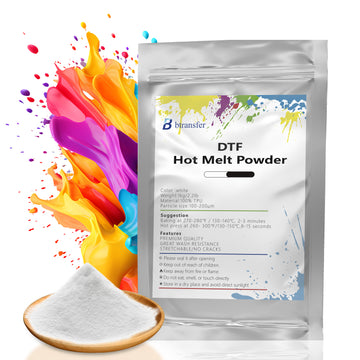
Although the DTF transfer film itself is usually PET, in the hot-melt adhesive powder used in traditional DTF processes, one of the common materials is TPU hot-melt adhesive.
In other words: DTF PET Film ≠ TPU Film.
The hot-melt adhesive layer in the DTF process may contain TPU.
So you also need to note: TPU hot-melt adhesive powder in DTF ≠ TPU 3D badge film.
Therefore, when comparing the two solutions, the best comparison is: TPU 3D badge film vs. DTF PET transfer film.
What materials are TPU 3D badge suitable for?
If used for 3D badges, logos, or raised markings, the TPU solution is better suited to compatible textiles and apparel products.
For example:
T-shirts
Hoodies
Hats
Denim apparel
Canvas bags
Sportswear
Footwear
Other compatible fabrics
Its advantage is not about replacing traditional DTF, but about offering another visual and tactile effect.
Traditional DTF is better suited for: high-definition, multi-color, relatively flat apparel graphics.
The TPU 3D badge solution is more oriented toward: logos, badges, brand marks, and decorative designs that require a slight raised tactile feel.
Specific applicable fabrics, temperature, pressure, and heat press time should be carried out according to the process parameters corresponding to the actual TPU film and equipment.

How should you choose between TPU and traditional DTF?
There’s really no absolute “which one is better.”
It depends on one key question: what kind of final product do you want to make.
If you want to create:
Large-area color apparel graphics
Photos
Illustrations
Multi-color text
Everyday T-shirt and hoodie customization
Traditional DTF is still a very mature solution.
If you prefer to make:
3D logos
Brand badges
Hat badges
Sports jersey badges
Decorative badges with a slight raised feel
Then the TPU 3D badge solution can offer another option.
The two processes can even serve different product lines, rather than one replacing the other.

If you already have DTF experience, is the TPU solution worth trying?
If you're already familiar with DTF, getting into TPU 3D badge production doesn't mean you have to relearn the entire personalized printing industry.
You're already familiar with many of the basics. What you really need to learn next is: a new consumables system, new printing logic, and new ways to apply the finished product.
This is also one reason the TPU solution is a good fit for users with DTF experience.
You can keep your existing DTF products and add 3D badges as a new production direction.
MU1730 3D Badge Solution: Give Your Next Product One More Possibility
If you're already familiar with DTF, the MU1730 3D badge solution is for you — especially if you already have apparel customization experience and want to expand your product types. You don't need to abandon your current DTF process; instead, you can add another production option.
Want to know which new product it might be suitable for? Start with a sample test.
If you'd also like to learn the full TPU 3D badge production process, the MU1730 3D badge solution includes step-by-step instructions from printing to transfer.


